

Department of Systems Biology
Research topics
Rafał Archacki Group
- Basic research: gene expression regulation related to chromatin and its role in controlling plant development and growth
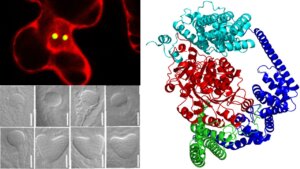
Our research focuses on several important chromatin regulators, primarily SWI/SNF-type chromatin remodelers. These occur in the cell nucleus of all eukaryotic organisms and are composed of a dozen or so proteins, including a central subunit with ATPase activity. SWI/SNF complexes are involved in the regulation of genes associated with key biological processes in both plants and animals, such as growth and development. Despite the well-established biological functions of SWI/SNF complexes, the exact mechanism of their action remains unclear. In addition to SWI/SNF complexes, we also study the regulatory functions of Polycomb-type complexes and linker histones. We use both classical genetic, molecular, and physiological analyses, as well as large-scale approaches, including transcriptomic analyses and profiling of chromatin protein binding in the Arabidopsis genome.
- Applied research: new regulators of plant growth
Our aim is to develop chemical molecules capable of modifying the growth of crop plants. We are searching for molecules that stimulate plant growth and productivity, as well as molecules with growth-inhibiting properties or potential herbicidal activity.
More information can be found on Group page.
Marta Koblowska Group
Our research focuses on how plants cope with challenging environmental conditions and how they regulate their genes in order to survive and thrive. At the center of our interests lies chromatin – an exceptionally dynamic structure composed of DNA and histone proteins, which determines which genes are active and which remain “silent.” It is already known that post-translational histone modifications, such as phosphorylation and acetylation of histone H3, act like molecular switches that rapidly respond to environmental cues.
We discovered that in plants such as Arabidopsis thaliana, stress triggers rapid changes in H3 histone phospho-acetylation, which is directly linked to the activation of genes responsible for adaptation. Moreover, we identified a protein complex that recognizes these modifications and cooperates with the cellular machinery responsible for alternative splicing – a process that increases the diversity of produced proteins. One of the proteins in this complex turned out to be indispensable for proper embryonic development in Arabidopsis, making it particularly important for understanding the fundamentals of plant biology.
To capture the full picture of this phenomenon, we employ state-of-the-art approaches – ranging from transcriptomic and proteomic analyses to protein structure studies. These methods allow us to trace how environmental signals are translated into chromatin changes, and subsequently influence RNA maturation and gene regulation.
Our findings point to a novel, previously undescribed mechanism that integrates cellular signaling, chromatin regulation, and splicing. Most importantly, both the histone modifications we studied and several of the proteins within the identified complex are evolutionarily conserved. This suggests that the mechanism we uncovered may represent a universal strategy of gene regulation across eukaryotes.
Maciej Kotliśnki Group
The research focuses on the role of histone H1 and its post-translational modifications in the regulation of chromatin structure, with particular emphasis on proteome alterations. The studies employ, among others, an Arabidopsis mutant lacking histone H1, synthetic H1 globular domains with post-translational modifications, and differential proteomics.