

Rafał Archacki Group
Gene expression regulation related to chromatin and its role in controlling plant development and growth
In eukaryotic cells, the integrity and activity of the nuclear genome are regulated to a large extent through structural changes in chromatin, commonly referred to as epigenetic changes. The nucleosome — a complex composed of DNA and histone proteins (H3, H4, H2A, and H2B) — constitutes the basic repeating structural unit of chromatin and serves as a substrate for numerous enzymatic proteins. Chromatin structure (simplified as chromatin condensation or decondensation) is thought to be controlled through the coordinated activity of a complex molecular machinery that modifies its core components. For example, DNA bases can undergo chemical modifications such as methylation, while histones are subject to a variety of post-translational modifications, including phosphorylation, acetylation, methylation, and others. Moreover, histones can occur as variants with distinct properties (e.g., canonical H2A and the variant H2A.Z).
Chromatin structure and nucleosome positioning are also altered through a process known as ATP-dependent chromatin remodeling. This process is mediated by large multiprotein complexes capable of repositioning nucleosomes, altering their composition, or removing them entirely from specific genomic loci. As a consequence, the accessibility of regulatory DNA sequences to other proteins, such as transcription factors, changes, potentially leading to altered expression of target genes. The ATP-dependent chromatin remodeling system is highly diversified — in vertebrates and higher plants, at least several distinct groups of remodeling complexes have been identified, each further diversified into specialized subtypes likely fulfilling specific biological functions.
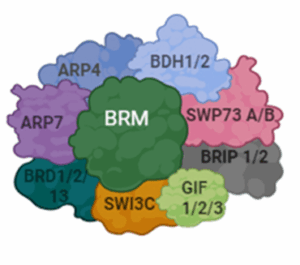
Fig.1. SWI/SNF complex containing BRM ATPase in Arabidopsis (credit: K. Kapela).
Among chromatin remodelers, SWI/SNF complexes are the best characterized. First discovered in yeast, they are evolutionarily conserved across all eukaryotes. SWI/SNF complexes consist of eight to more than a dozen proteins, including the catalytic ATPase subunit SNF2, core subunits required for efficient remodeling activity in vitro, and additional regulatory proteins with diverse functions. In mammals and higher plants, nearly all SWI/SNF subunits are encoded by two or more paralogs and can assemble into several distinct complex subtypes: BAF and ncBAF, and in mammals additionally PBAF. The model plant Arabidopsis thaliana contains four SWI/SNF-type ATPases (BRM, SYD, CHR12, and CHR23). Among them, BRM shows the highest similarity to yeast and animal ATPases, contains a characteristic C-terminal bromodomain, and is a component of ncBAF-type complexes (Fig.1).
Previous studies, including our own work, have provided substantial insight into the biological functions of SWI/SNF complexes across different organisms. These complexes participate in the transcriptional regulation of key processes such as the cell cycle, differentiation, stress responses, and developmental gene expression programs. SWI/SNF complexes are also important components of numerous signaling pathways, and dysfunction of human SWI/SNF complexes has been strongly linked to multiple cancer types. In plants, SWI/SNF complexes are involved in the regulation of embryogenesis, leaf and flower development, floral transition, hormone signaling pathways, and stress responses.
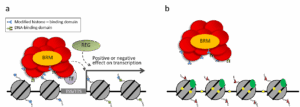
Fig.2. Recruitment of SWI/SNF complexes. (a) SWI/SNF complexes can bind to regulatory DNA sequences (including promoters and terminators) and either activate or repress transcription. Their recruitment is facilitated by protein–protein interactions with transcription factors (TFs) and other chromatin regulators (REGs), as well as by the presence of domains recognizing specific DNA structures or histone modifications. (b) In Arabidopsis, SWI/SNF localization is negatively correlated with the presence of DNA methylation (yellow), certain histone modifications such as H3K27me3 (brown), and linker histones H1 (green). Source: Jerzmanowski i Archacki (2017), Universal and Lineage-Specific Properties of Linker Histones and SWI/SNF-Chromatin Remodeling Complexes in Plants, doi: 10.1007/978-3-319-55520-1_23.
Importantly, despite their involvement in numerous biological processes, SWI/SNF complexes act in a highly specific manner. Under particular physiological conditions, they are targeted to defined genomic regions — mainly promoters in yeast, promoters and enhancers in mammals, and promoters and terminators in Arabidopsis. As a result, only selected genes or gene groups are regulated in a given cell type or developmental stage. The mechanisms underlying SWI/SNF recruitment to target loci remain incompletely understood. Protein–protein interactions with transcription factors, as well as interactions with modified nucleosomes mediated by specialized protein domains (such as bromodomains recognizing acetylated histones), are thought to play major roles in this process. Linker histones H1 may also contribute significantly to SWI/SNF recruitment and activity (Fig.2).
Current research
We are currently developing several research directions related to chromatin-level regulation:
- The role of SWI/SNF complexes in the regulation of shoot architecture in Arabidopsis and barley
Research conducted within the NCN Opus project (2025/57/B/NZ3/05020)
Open PhD positions available - Mechanisms of action and regulation of SWI/SNF complexes in Arabidopsis
Research conducted within the NCN Sonata Bis project (2017/26/E/NZ2/00899) and the NCN Preludium project (2023/49/N/NZ2/03263, led by Katarzyna Kapela) - Functional links between chromatin remodelers, H1 histones, and PRC complexes in Arabidopsis
Research conducted within the NCN Sonata Bis project (2017/26/E/NZ2/00899) and the NCN Preludium project (2021/41/N/NZ2/04423, led by Ewelina Małecka)
Applied research: new regulators of plant growth
Applied research conducted in our laboratory has focused on the identification of novel chemical compounds capable of modifying the growth of crop plants, including substances with potential applications as plant growth regulators or herbicides. According to current forecasts, the global demand for plant-derived products will continue to increase due to both the growing human population and the needs of various industrial sectors. The major strategies used to intensify plant production include the development of new crop varieties and the use of plant protection products such as growth regulators, herbicides, fungicides, and insecticides. Within these groups, there is a continuous demand for new compounds with improved efficacy and safety profiles. In the case of herbicides, this need is largely driven by the increasing resistance of weeds to commonly used active substances caused by strong selective pressure. In addition, changing environmental and societal expectations have led to the gradual withdrawal of highly toxic compounds introduced in the 1960s and 1970s. These trends are reflected in current European legislation, including the European Green Deal strategy.
As part of our research, we used cheminformatics approaches (in collaboration with the group of Dr. hab. Paweł Siedlecki at the Institute of Biochemistry and Biophysics PAS) to generate libraries of molecules predicted in silico to bind selected plant proteins that are not targeted by currently used agricultural active compounds. These molecules were subsequently tested for their biological activity using Arabidopsis (phenotypic assays and gene expression analyses), followed by validation in additional plant species. Through phenotypic screening, we identified a compound called thiowangamycin (TSGM), which, depending on the applied concentration, either caused plant death or strongly inhibited growth, demonstrating herbicide-like activity. The compound was further characterized with respect to its biological activity and toxicity profile. The obtained results formed the basis for patent applications covering the use of TSGM as a herbicidal compound (PL 240721, EP 20797545). Commercialization of TSGM is currently being pursued by the spin-off company Upgrow sp. z o.o.
Current research directions related to plant growth regulators include:
-
characterization of active compounds identified in phenotypic screens
-
development and validation of novel AI/ML-based predictive models for agrochemical compounds.
These studies are carried out in collaboration with the Institute of Biochemistry and Biophysics PAS in Warsaw and Faculty of Informatics, AGH in Kraków, within the framework of the NCN Opus project (2025/57/B/ST4/03400; project leader: Dr. hab. Paweł Siedlecki, IBB PAS).